
Article Sidebar

Main Article Content
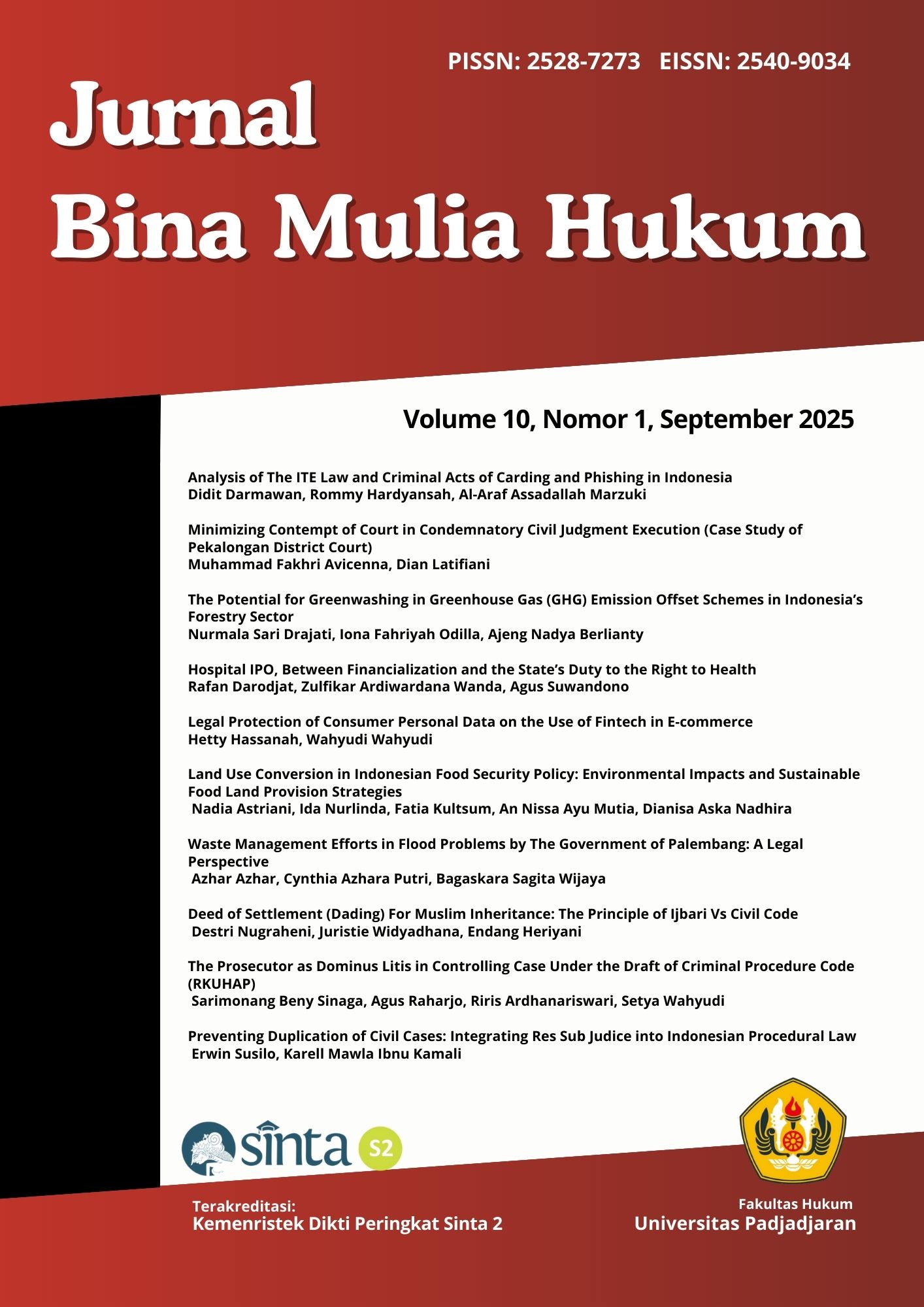
Abstract
Introduction to the Problem: The execution of condemnatory civil judgments in the Pekalongan District Court faces resistance, resulting in stagnation at the implementation level. This problem is underpinned by the actions of the execution respondents, which conceptually align with Contempt of Court.
Purpose/Study Objectives: This article aims to analyze actions identified as forms of Contempt of Court during execution in the Pekalongan District Court and efforts to minimize such actions.
Novelty: In the Pekalongan District Court, the concept can be conceptually classified as Contempt of Court, an angle that has received little focused attention in Indonesian judicial research.
Methodology: By employing normative-empirical research and based on qualitative descriptive analysis, this article concludes that there is interference in the administration of justice in the form of non-compliance with aanmaning (warning) and unlawful physical resistance cumulatively carried out by the execution respondents, which is inherently related to the doctrine of Contempt of Court from a conceptual perspective, and contrary to the Herzien Inlandsch Reglement (HIR).
Results/Findings: Minimizing Contempt of Court involving state security elements and proposing the drafting of legislation related to Contempt of Court that accommodates actions, behaviors, attitudes, and/or statements that can undermine the authority, dignity, and honor of the judiciary.
Keywords
Article Details

This work is licensed under a Creative Commons Attribution 4.0 International License.
References
- Books
- Andi Hamzah dan Bambang Waluyo, Tindak Pidana Terhadap Penyelenggaraan Peradilan (Contempt of Court), Sinar Grafika, Jakarta: 2017.
- Dian Latifiani, Hukum Acara Perdata Dalam Praktik Peradilan Secara Elektronik, UNNES Press, Semarang: 2023.
- Henry Campbell Black, Black’s Law Dictionary: Definitions of the Terms and Phrases of American and English Jurisprudence, Ancient and Modern, Revised Fourth Edition, The Publisher Editorial Staff Publishing, St. Paul Minnesota: 1968.
- Luhut Pangaribuan, Hukum Pidana Khusus, Pustaka Kemang, Depok: 2016
- Nandang Sunandar, Eksekusi Putusan Perdata: Proses Eksekusi Dalam Tataran Teori dan Praktik, Nuansa Cendekia, Bandung: 2021.
- Sudikno Mertokusumo, Hukum Acara Perdata Indonesia, Liberty, Yogyakarta: 2021.
- Yahya Harahap, Ruang Lingkup Permasalahan Eksekusi Bidang Perdata, Edisi Kedua Cetakan ke-10, Sinar Grafika, Jakarta: 2022.
- Yahya Harahap, Hukum Acara Perdata, Sinar Grafika, Jakarta: 2017.
- Journals
- Ahmad Habib Alfikry (et.al.), “National Law Development through Civil Procedure Law Reform as a Manifestation of State Goals during the Covid-19 Pandemic”, Lex Scientia Law Review. Vol. 5, No. 2, 2021.
- Ani Triwati (et.al.), “Upaya Hukum Peninjauan Kembali Dalam Perkara Pidana Pasca Putusan Mahkamah Konstitusi”, Jurnal Dinamika SosBud, Vol. 17, No. 2, 2017.
- Anita Afriana (et.al.), “Contempt of Court: Penegakan Hukum Dan Model Pengaturan di Indonesia”, Jurnal Hukum dan Peradilan, Vol. 7, No. 3, 2018.
- Budi Suhariyanto, “Contempt of Court Dalam Perspektif Hukum Progresif (Kajian Putusan Nomor 241/Pid.B/2006/PN.PWK)”, Jurnal Yudisial, Vol. 9, No. 2, 2016.
- Dara Puspita Riyawan (et.al.), “Analisis Yuridis Mengenai Peran Kode Etik Terhadap Profesi Hakim”, Jurnal Hukum dan Kewarganegaraan, Vol. 1, No. 6, 2023.
- Dian Latifiani (et.al.), “Implementation of Simple, Fast and Low-Cost Principles in E-Summons with the E-Court System”, Diponegoro Law Review, Vol. 8, No. 1, 2023.
- Dian Latifiani, “Permasalahan Pelaksanaan Putusan Hakim”, ADHAPER: Jurnal Hukum Acara Perdata, Vol. 1, No. 1, 2015.
- Dwi Maryono dan Muhamad Azhar, “Eksekusi Putusan Pengadilan Hubungan Industrial: Beberapa Catatan Masukan RUU Hukum Acara Perdata”, Administrative Law And Governance Journal, Vol. 1, Edisi. 2, 2018, hlm. 349.
- Endhang Boedhiarti, “Urgensi Pengayuran Contempt of Court di Indonesia di Masa Yang Akan Datang (Ius Constituendum)”, Jurnal Juristic, Vol. 2, No. 2, 2021, hlm. 196-197.
- Freidelino de Sousa, “Ketidakpatuhan Terhadap Putusan Mahkamah Konstitusi Sebagai Suatu Perbuatan Contempt of Court”, Indonesian State Law Review, Vol. 5, No. 1, 2022.
- Indra Priyono (et.al.), “Pelaksanaan Eksekusi Atas Putusan Perkara Perdata Pengadilan Negeri Bogor Nomor 36/PDT/G/2009/PN.BGR”, Karimah Tauhid, Vol. 3, No. 1, 2024, hlm. 908.
- I Wayan Parta dan Nyoman Gede Remaja, “Peranan Kepolisian Dalam Pengamanan Pelaksanaan Putusan Pengadilan Perdata Yang Bersifat Condemnatory di Wilayah Hukum Kepolisian Resor Buleleng”, Kertha Widya: Jurnal Hukum, Vol. 8, No. 1, 2020.
- Jimly Asshiddiqie, “Upaya Perancangan Undang-Undang Tentang Larangan Merendahkan Martabat Pengadilan (Contempt of Court)”, Jurnal Hukum dan Peradilan, Vol. 4, No. 2, 2015.
- Melani Yustianing (et.al.), “Tinjauan Perlawanan untuk Menunda Eksekusi dalam Sengketa Perdata (Studi Kasus Perkara No: 8/Pdt. Plw/2000/PN Probolinggo)”, Jurnal Verstek, Vol. 2, No. 3, 2014.
- Musmuliadin (et.al.), “Contempt of Court in Renewal of Indonesian Criminal Law Based on Pancasila”, Proceeding International Conference Restructuring and Transforming Law, Vol. 1, Issue 1, 2022.
- Nasrun Hipan (et.al.), “Problematika Penyelesaian Sengketa Tanah Di Lokasi Tanjung Sari Kabupaten Banggai”, Jurnal Law Reform, Vol. 14, No. 2, 2018.
- Nur Kholis, “Asas Non Diskriminasi Dalam Contempt of Court”, Legality: Jurnal Ilmiah Hukum, Vol. 26, No. 2, 2019.
- Opik Rozikin, “Contempt of Court Dalam Peraturan Perundang-Undangan di Indonesia”, Jurnal CIC: Lembaga Riset dan Konslutan Sosial, Vol. 1, No.1, 2019.
- Otto Hasibuan, “Contempf of Court di Indonesia, Perlukah?”, Jurnal Hukum dan Peradilan, Vol. 4, No. 2, 2015.
- Rizaldy Pedju, “Politics, Islam, Islamic Trade Law, Nationalism: Titik Singgung Kompetensi Peradilan Umum (Perdata) dan Peradilan Tata Usaha Negara Secara Kompetensi Absolut (Absolute Competency)” Jurnal Potret Pemikiran, Vol. 21, No.1, 2017.
- RR Lyia Aina Prihardiati, “Teori Hukum Pembangunan Antara Das Sein Dan Das Sollen”, HERMENEUTIKA: Jurnal Ilmu Hukum, Vol. 5, No. 1. 2021.
- Ruby Hadiarti Johny, “Contempt of Court (Kajian Tentang Ide Dasar Dan Implementasinya Dalam Hukum Pidana)”, Jurnal Dinamika Hukum, Vol. 9, No. 2, 2009.
- Salman Alfarisi dan Muhammad Syaiful Hakim, “Hubungan Sosiologi Hukum dan Masyarakat Sebagai Kontrol Sosial”, Jurnal Rechten: Riset Hukum dan Hak Asasi Manusia, Vol. 1, No.2, 2019.
- Syarif Nurhidayat, “Pengaturan dan Ruang Lingkup Contempt of Court di Indonesia”, Jurnal Ius Constituendum, Vol. 6 No. 2, 2021.
- Wellem A. E. Wasia, “Contempt of Court (Penghinaan Terhadap Lembaga Peradilan) Kaitannya Dengan Kekuasaan Kehakiman Yang Mandiri Menurut UU No. 48 Tahun 2009”, Lex Administratum, Vol. 6, No. 2, 2018.
- Legislations
- Undang-Undang Dasar Negara Republik Indonesia Tahun 1945.
- Herzien Inlandsch Reglement (H.I.R) (S. 1941-44).
- The Administration of Justice (Protection) Act 2016.
- Undang-Undang Nomor 48 Tahun 2009 tentang Kekuasaan Kehakiman.
- Undang-Undang Nomor 2 Tahun 2002 tentang Kepolisian Negara Republik Indonesia.
- Undang-Undang Nomor 14 Tahun 1985 tentang Mahkamah Agung.
- Other Resources
- Direktorat Jenderal Badan Peradilan Umum Mahkamah Agung Republik Indonesia, Aplikasi Pengawasan Elektronik Eksekusi (PERKUSI),
- Jebabun (et.al.), 2018, Asesmen Awal Permasalahan Eksekusi Putusan Perkara Perdata di Indonesia (Initial Assessment Problems of Court Decision Enforcement System in Indonesia),
- Naskah Akademik Rancangan Undang-Undang Kitab Undang-Undang Hukum Pidana.
References
Books
Andi Hamzah dan Bambang Waluyo, Tindak Pidana Terhadap Penyelenggaraan Peradilan (Contempt of Court), Sinar Grafika, Jakarta: 2017.
Dian Latifiani, Hukum Acara Perdata Dalam Praktik Peradilan Secara Elektronik, UNNES Press, Semarang: 2023.
Henry Campbell Black, Black’s Law Dictionary: Definitions of the Terms and Phrases of American and English Jurisprudence, Ancient and Modern, Revised Fourth Edition, The Publisher Editorial Staff Publishing, St. Paul Minnesota: 1968.
Luhut Pangaribuan, Hukum Pidana Khusus, Pustaka Kemang, Depok: 2016
Nandang Sunandar, Eksekusi Putusan Perdata: Proses Eksekusi Dalam Tataran Teori dan Praktik, Nuansa Cendekia, Bandung: 2021.
Sudikno Mertokusumo, Hukum Acara Perdata Indonesia, Liberty, Yogyakarta: 2021.
Yahya Harahap, Ruang Lingkup Permasalahan Eksekusi Bidang Perdata, Edisi Kedua Cetakan ke-10, Sinar Grafika, Jakarta: 2022.
Yahya Harahap, Hukum Acara Perdata, Sinar Grafika, Jakarta: 2017.
Journals
Ahmad Habib Alfikry (et.al.), “National Law Development through Civil Procedure Law Reform as a Manifestation of State Goals during the Covid-19 Pandemic”, Lex Scientia Law Review. Vol. 5, No. 2, 2021.
Ani Triwati (et.al.), “Upaya Hukum Peninjauan Kembali Dalam Perkara Pidana Pasca Putusan Mahkamah Konstitusi”, Jurnal Dinamika SosBud, Vol. 17, No. 2, 2017.
Anita Afriana (et.al.), “Contempt of Court: Penegakan Hukum Dan Model Pengaturan di Indonesia”, Jurnal Hukum dan Peradilan, Vol. 7, No. 3, 2018.
Budi Suhariyanto, “Contempt of Court Dalam Perspektif Hukum Progresif (Kajian Putusan Nomor 241/Pid.B/2006/PN.PWK)”, Jurnal Yudisial, Vol. 9, No. 2, 2016.
Dara Puspita Riyawan (et.al.), “Analisis Yuridis Mengenai Peran Kode Etik Terhadap Profesi Hakim”, Jurnal Hukum dan Kewarganegaraan, Vol. 1, No. 6, 2023.
Dian Latifiani (et.al.), “Implementation of Simple, Fast and Low-Cost Principles in E-Summons with the E-Court System”, Diponegoro Law Review, Vol. 8, No. 1, 2023.
Dian Latifiani, “Permasalahan Pelaksanaan Putusan Hakim”, ADHAPER: Jurnal Hukum Acara Perdata, Vol. 1, No. 1, 2015.
Dwi Maryono dan Muhamad Azhar, “Eksekusi Putusan Pengadilan Hubungan Industrial: Beberapa Catatan Masukan RUU Hukum Acara Perdata”, Administrative Law And Governance Journal, Vol. 1, Edisi. 2, 2018, hlm. 349.
Endhang Boedhiarti, “Urgensi Pengayuran Contempt of Court di Indonesia di Masa Yang Akan Datang (Ius Constituendum)”, Jurnal Juristic, Vol. 2, No. 2, 2021, hlm. 196-197.
Freidelino de Sousa, “Ketidakpatuhan Terhadap Putusan Mahkamah Konstitusi Sebagai Suatu Perbuatan Contempt of Court”, Indonesian State Law Review, Vol. 5, No. 1, 2022.
Indra Priyono (et.al.), “Pelaksanaan Eksekusi Atas Putusan Perkara Perdata Pengadilan Negeri Bogor Nomor 36/PDT/G/2009/PN.BGR”, Karimah Tauhid, Vol. 3, No. 1, 2024, hlm. 908.
I Wayan Parta dan Nyoman Gede Remaja, “Peranan Kepolisian Dalam Pengamanan Pelaksanaan Putusan Pengadilan Perdata Yang Bersifat Condemnatory di Wilayah Hukum Kepolisian Resor Buleleng”, Kertha Widya: Jurnal Hukum, Vol. 8, No. 1, 2020.
Jimly Asshiddiqie, “Upaya Perancangan Undang-Undang Tentang Larangan Merendahkan Martabat Pengadilan (Contempt of Court)”, Jurnal Hukum dan Peradilan, Vol. 4, No. 2, 2015.
Melani Yustianing (et.al.), “Tinjauan Perlawanan untuk Menunda Eksekusi dalam Sengketa Perdata (Studi Kasus Perkara No: 8/Pdt. Plw/2000/PN Probolinggo)”, Jurnal Verstek, Vol. 2, No. 3, 2014.
Musmuliadin (et.al.), “Contempt of Court in Renewal of Indonesian Criminal Law Based on Pancasila”, Proceeding International Conference Restructuring and Transforming Law, Vol. 1, Issue 1, 2022.
Nasrun Hipan (et.al.), “Problematika Penyelesaian Sengketa Tanah Di Lokasi Tanjung Sari Kabupaten Banggai”, Jurnal Law Reform, Vol. 14, No. 2, 2018.
Nur Kholis, “Asas Non Diskriminasi Dalam Contempt of Court”, Legality: Jurnal Ilmiah Hukum, Vol. 26, No. 2, 2019.
Opik Rozikin, “Contempt of Court Dalam Peraturan Perundang-Undangan di Indonesia”, Jurnal CIC: Lembaga Riset dan Konslutan Sosial, Vol. 1, No.1, 2019.
Otto Hasibuan, “Contempf of Court di Indonesia, Perlukah?”, Jurnal Hukum dan Peradilan, Vol. 4, No. 2, 2015.
Rizaldy Pedju, “Politics, Islam, Islamic Trade Law, Nationalism: Titik Singgung Kompetensi Peradilan Umum (Perdata) dan Peradilan Tata Usaha Negara Secara Kompetensi Absolut (Absolute Competency)” Jurnal Potret Pemikiran, Vol. 21, No.1, 2017.
RR Lyia Aina Prihardiati, “Teori Hukum Pembangunan Antara Das Sein Dan Das Sollen”, HERMENEUTIKA: Jurnal Ilmu Hukum, Vol. 5, No. 1. 2021.
Ruby Hadiarti Johny, “Contempt of Court (Kajian Tentang Ide Dasar Dan Implementasinya Dalam Hukum Pidana)”, Jurnal Dinamika Hukum, Vol. 9, No. 2, 2009.
Salman Alfarisi dan Muhammad Syaiful Hakim, “Hubungan Sosiologi Hukum dan Masyarakat Sebagai Kontrol Sosial”, Jurnal Rechten: Riset Hukum dan Hak Asasi Manusia, Vol. 1, No.2, 2019.
Syarif Nurhidayat, “Pengaturan dan Ruang Lingkup Contempt of Court di Indonesia”, Jurnal Ius Constituendum, Vol. 6 No. 2, 2021.
Wellem A. E. Wasia, “Contempt of Court (Penghinaan Terhadap Lembaga Peradilan) Kaitannya Dengan Kekuasaan Kehakiman Yang Mandiri Menurut UU No. 48 Tahun 2009”, Lex Administratum, Vol. 6, No. 2, 2018.
Legislations
Undang-Undang Dasar Negara Republik Indonesia Tahun 1945.
Herzien Inlandsch Reglement (H.I.R) (S. 1941-44).
The Administration of Justice (Protection) Act 2016.
Undang-Undang Nomor 48 Tahun 2009 tentang Kekuasaan Kehakiman.
Undang-Undang Nomor 2 Tahun 2002 tentang Kepolisian Negara Republik Indonesia.
Undang-Undang Nomor 14 Tahun 1985 tentang Mahkamah Agung.
Other Resources
Direktorat Jenderal Badan Peradilan Umum Mahkamah Agung Republik Indonesia, Aplikasi Pengawasan Elektronik Eksekusi (PERKUSI),
Jebabun (et.al.), 2018, Asesmen Awal Permasalahan Eksekusi Putusan Perkara Perdata di Indonesia (Initial Assessment Problems of Court Decision Enforcement System in Indonesia),
Naskah Akademik Rancangan Undang-Undang Kitab Undang-Undang Hukum Pidana.